Event

Taking Pictures + Past Life PicturesquePost an Event »

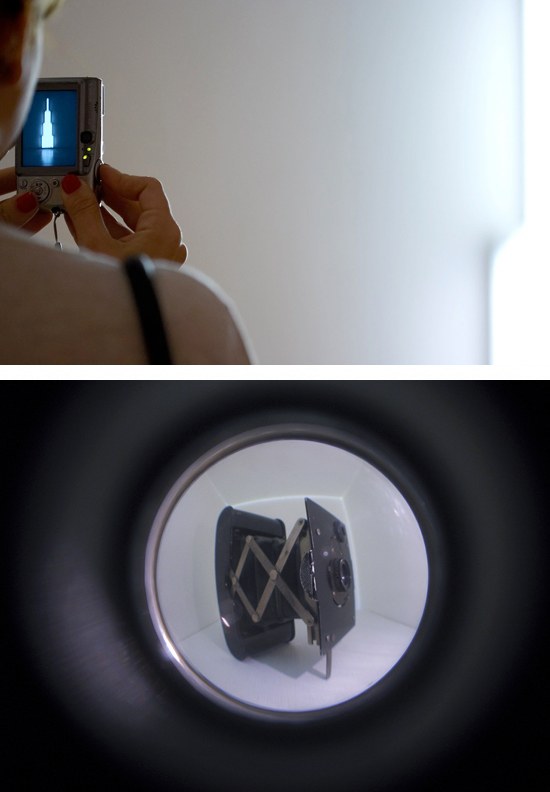
Taking Pictures + Past Life Picturesque Nicholas Knight, Taking Pictures (Flavin), 2008, archival pigment print mounted on aluminum , 20 x 30 inches Below: Jo Babcock, Untitled, 2007, assemblage, 4-1/2 x 2-1/2 x 3 inches
Steven Wolf Fine Arts September 11-October 10 Opening Reception Friday September 11, 6-8 pm In Taking Pictures, Nicholas Knight haunts the galleries of art museums, photographing people in the act of taking pictures. Like an anthropologist in the bush, Knight captures the peculiar comportment of the museum-goer, and finds that directly looking at an artwork is often replaced by the need to see the thing through the camera’s screen. His own pictures of pictures of pictures create a breathless daisy chain of picture-taking that finds its endgame in a crepuscular video Götterdämmerung, in which the artist is seen hand-cranking a slide projector show of his own picture-taking. It’s picture-in-picture as a repeating decimal. --- Jo Babcock could go down in history as the only photographer to successfully crack the competitive field of San Francisco Bay Area assemblage. In the 1980s, Babcock began making pin hole cameras from found objects. They all work and produce a picture unique to their construction. The most beguiling ones refer to the strange relationship between sculpture and photography that make up their identity. Take, for instance, the camera made from an old, believe it or not, Ansel Adams coffee can; or, the one made from a Brillo box; or the one made from a can of Mr. Painter latex flat paint. The charm of these objects reveals itself on contact and needs no explanation. Other cameras are more obscure but equally interesting, such as the mailbox camera, the one made from a toy safe and the one made from an old box of Chanukah candles. At rest cameras are slightly disturbing. Are you looking at them or are they looking at you. Babcock’s cameras, haunted by a past life, seem to embody a specific if dormant spirit. And as their Dr. Frankenstein, it is Babcock who holds the key to their unholy reanimation. According to curator Doug Nickel, who wrote the essay to Babcock’s 2005 The Invented Camera, this can be said to occur when Babcock uses the cameras to make photographs. Each camera is deployed by Babcock to take pictures of things as though from its own perspective, giving it a sense of viewpoint and independence. The band-aid box camera, for instance, snapped a self-portrait of an injured Babcock. Nickel argues that Babcock’s cameras with their self-defining point of view, fulfill the camera’s destiny of independence embedded in its 19th century invention.