Event

Natural Histories: The Crooked Timber and other paintings and drawings + Elixir IVPost an Event »

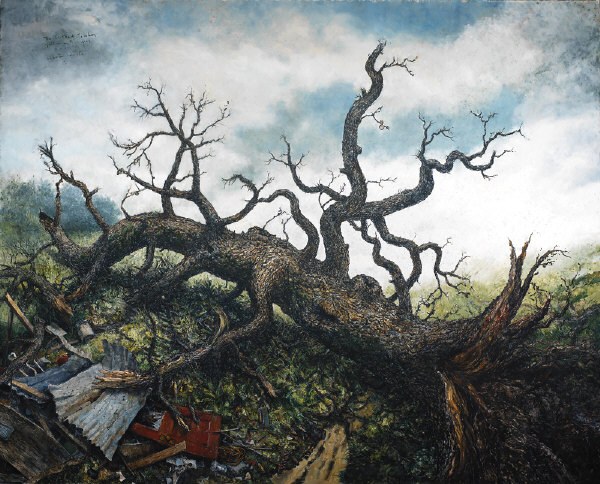
Natural Histories: The Crooked Timber and other paintings and drawings + Elixir IV Chester Arnold,Chester Arnold, The Crooked Timber, 2010, Oil on linen, 78 x 96 inches
Solo Exhibition Chester Arnold: Natural Histories: The Crooked Timber and other paintings and drawings Media Room Marina Zurkow: Elixir IV Reception Saturday, May 22, 10am–noon Catharine Clark Gallery is pleased to present Chester Arnold’s solo exhibition, Natural Histories: The Crooked Timber and other paintings and drawings, in the main galleries, and Marina Zurkow’s work, Elixir IV, in the media room. The exhibition dates are May 22­–July 3, 2010, and Arnold will be present for the brunch reception on Saturday, May 22, 10am–noon. The Saturday morning opening reception coincides with the San Francisco Fine Art Fair at Fort Mason (May 20 -23) (Booth 68). Free day-passes are available at www.sffineartfair.com/clark. The title of Chester Arnold’s solo exhibition, Natural Histories: The Crooked Timber and other paintings and drawings, is appropriated from one of his favorite quotes by the 18th-century German philosopher Immanuel Kant: “from the crooked timber of humanity, nothing strait was ever made.” Inspiration for this body of work came, in part, from Arnold’s winter stay in Yosemite National Park. There he noticed gnarled roots and fallen trees punctuating the environment, riddling the landscape with austerity and beauty—an environment modified by time, weather, and human hand. For his works on paper that portray severed tree stumps and craggy soil, Arnold hand makes the sepia-colored ink from local oak-galls and rust, old coffee, and soil—recipes he learned while teaching a course on historic methods and materials. In both paintings and drawings, Arnold places the viewer at an ambiguous remove—not quite in the environment, but not quite safely removed from it either. In the painting titled Histories, Arnold addresses how the close vantage point forces the question, “have I stumbled by the stump of an ancient tree hastily downed by loggers, or am I the source of its downfall?” In The Bridge at Dover Beach, the viewer is placed at what has become Arnold’s signature third-story viewing height—precariously hovering above the chasm of a striated cliff and distant shore—a deteriorating wooden bridge suggests that the path traveled would result in a mortal fall. American by birth, but raised in post-war Germany during the formative years of his childhood, Chester Arnold is interested in the capacity of painting to convey the complexities of the human psyche. His compositions present skewed linear perspectives that place the viewer at a remove, above and beyond an unfolding narrative. The romantic beauty of natural landscapes, in part informed by such historic master as Caspar David Friedrich, is subverted by Arnold’s preoccupation with the detritus of human accumulation. Arnold’s work will be presented as a survey exhibition at the Nevada Museum of Art, On Earth as it is in Heaven, from August 14 through October 17, 2010, and will be accompanied by a catalogue. For more information on the exhibit: www.nevadaart.org. In 2008 Arnold’s work was included in the San Jose Institute of Contemporary Art’s exhibition highlighting 2005 recipients of the Eureka Fellowship. Arnold’s exhibition history includes Donald Kuspit’s selection of his work for New Old Masters at the National Museum in Gdańsk, Poland (2006), and a major solo exhibition at the San Jose Museum of Art that was accompanied by a catalogue. Arnold’s work is further represented in the public collections of many institutions, including the Smithsonian American Art Museum, the Pasadena Museum of California Art, the Nevada Museum of Art, the di Rosa Preserve: Art and Nature, the Tacoma Museum of Art, and the San Jose Museum of Art, and has been critically reviewed in Artforum, Works + Conversation, and the San Francisco Chronicle. He lives and works in Sonoma, California, and had his first exhibition at Catharine Clark Gallery in 2003. Marina ZurkowPresented in the media room is Marina Zurkow’s Elixir IV. The Elixir Series describes impossible landscapes: cut-crystal bottles bobbing and tossing like buoys in the ocean, beacons bearing potions, poisons, messages, and genies. Each bottle contains an animated figure engaged in a repeated, metronomic action. In Elixir I, a woman is rowing; in Elixir II, a blindfolded man stumbles to stay upright. Elixir III holds a young girl trying to fly with paper wings; and in Elixir IV, a high-diver twists and arcs, while the bottle presses forward in an Antarctic landscape. The highly layered video treatment pays tribute to the 19th century Russian painter Ivan Aivazovsky, whose portentous, luminous paintings of tiny ships on huge swells of ocean both mesmerize and terrify the viewer. Marina Zurkow makes psychological narratives about humans and their relationship to animals, plants and the weather. Her work takes the form of multi-channel videos, customized multi-screen computer pieces, animated cartoons, interactive mobile works, and pop objects. She has exhibited at The Sundance Film Festival, The Rotterdam Film Festival, Res Fest, Ars Electronica, Creative Time, The Kitchen, The Walker Art Center, the Brooklyn Museum, The National Museum for Women in the Arts, and Eyebeam, Bryce Wolkowitz Gallery, New York, among other venues. Her videos have been broadcast on MTV, FujiTV, and PBS. She is a 2005 NYFA Fellow, a 2003 Rockefeller New Media Fellow, and a 2001 Creative Capital grantee. Zurkow teaches at NYU's Interactive Telecommunications Program (ITP), and lives in Brooklyn, NY. This is her first exhibition at Catharine Clark Gallery.