Event

Heroes and AnimalsPost an Event »

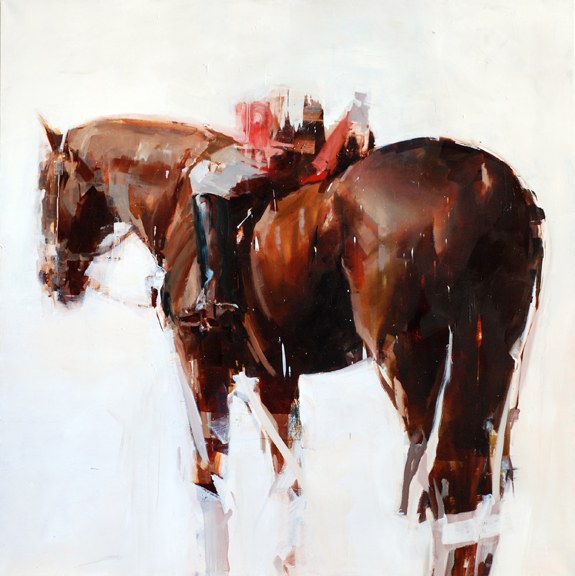
Heroes and Animals Polish Rider 2, oil on canvas, 66" x 66"
Dolby Chadwick Gallery is pleased to announce Heroes and Animals, an exhibition of new paintings by Alex Kanevsky. To look at a painting by Kanevsky is to look at it for the first time, even if one has visited the piece before. By condensing the structure, content and assorted ephemera of a given scene into a single, saturated moment, refigured forms and gestures are continually impelled to the painting’s surface only to recede in accommodation of future findings. Such honesty and freshness is rooted in Kanevsky’s fidelity to a naïve gaze, an exercise in which the faculties of knowledge are constantly reset so as to stave off tidy assumptions about how things work or what they mean. By remaining open to an ever-evolving vision of the world, Kanevsky’s paintings deliberately defy stylistic and thematic pigeonholing in an art world obsessed with taxonomic boundaries. His manner of painting is instead motivated by a desire to generate dialogue between subjective personal perception, external reality, and the tenuousness of translation. As Kanevsky explains, “if painting is a form of language, I attempt to create a language, foreign to all but myself, and then say a few things in that language in such a way that would make them clear to anybody who listens, even if the language remains foreign to the listener.” In order to reconcile these fissures between self-expression and communication, between the real and the represented, Kanevsky adopts a technique predicated on the idea of continuous exchange, or fluid conversation. By building up diaphanous layers of paint – each describing a singular, fleeting frame – the resultant painting becomes a palimpsest of elapsed time, like a photograph blurred due to a slow shutter speed. The almost cinematic quality of the compositions’ temporal and spatial siting echoes the dynamism and intensity of Kanevsky’s brushstrokes, which further amplify the sense of motion that both constitutes and defines his sense of the world. These subtly abstracted figures and landscapes work to free the viewer’s own gaze, thereby revealing what unifocal depiction compels us to overlook. Energy and movement, however, are counterbalanced by an equally palpable sense of stillness. This quiet is manifested in the deeply contemplative moods his paintings evoke and the ethereal quality produced by their visual vigor. Such a paradoxical coupling of forces is exquisitely embodied by Polish Rider 2 (2010), in which the stillness of a hunting horse at rest is held in check by the potential energy contained within the animal’s powerful musculature. The horse’s anonymity, the indeterminate positioning of its rear legs and the dematerialized torso of its rider elicit an ambiguity that nimbly suspends tranquility and flight in favor of an otherworldly middle ground. His luminous colors, which arrive at the canvas well mixed to preserve their clarity, are also fundamental to the compositions’ affective impact. Against lush, richly hued underlayers is set a constellation of brilliant daubs that assume, without overly aping, the way light weaves through tree leaves or skirts into a room through billowing curtains. Stéphane Mallarmé’s description of how Edouard Manet’s compositions feel “deluged with air” aptly captures the thick, whirling atmosphere in Kanevsky’s paintings, particularly in outdoor scenes such as River House (2010) and Irish Cow (2010). Indeed, Kanevsky’s rendering of light and atmosphere through brushwork and coloristic nuance – where flesh is modeled in shifting pinks, purples and greens and shadows are described in complementary colors instead of grey – recalls practices of 19th century Impressionism. But unlike the Impressionists or other artists working in traditions concerned with problems of perception and representation, Kanevsky sees the inherent multiplicity of reality as the means through which universal communication can be bridged. And with their psychological components and modern pathos, his works are defiantly of the contemporary moment. Ideas of vision and knowledge aside, Kanevsky’s paintings are deeply personal exercises that carry a distinct emotional weight. They ask questions without demanding answers, since answers, regardless of their supposed veracity, extinguish the most enriching pursuit of all: exploration for its own sake. Alex Kanevsky was born in Rostvo-na-Donu, Russia, in 1963 and graduated from the Pennsylvania Academy of Fine Arts in 1993. He has received numerous prestigious fellowships and awards, including the Pew Fellowship for painting in 1997. In addition to exhibiting work across North America and Europe, his work has been reviewed in The LA Times, The New York Observer, The Philadelphia Inquirer and New American Paintings. His work is included in the permanent collection of the Achenbach Collection, San Francisco Museum of Fine Arts, de Young & Legion of Honor.