Event

Stephen De StaeblerPost an Event »

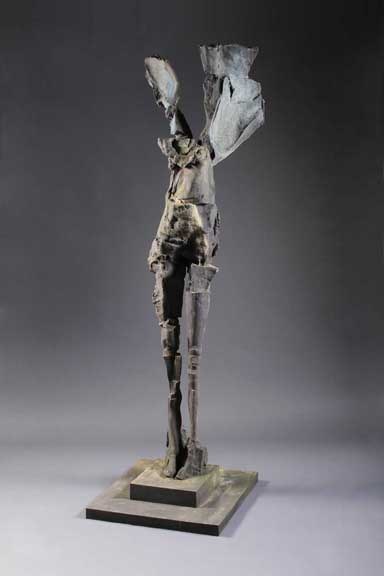
Stephen De Staebler Stephen De Staebler, Winged Figure Ascending (2011), bronze, 108 x 32" x 33"
Dolby Chadwick Gallery is pleased to announce an exhibition of bronze sculptures by the late artist Stephen De Staebler (March 1933 – May 2011). Having worked primarily in clay for the first part of his career, De Staebler began making works in bronze during the late 1970s. Rather than viewing the two mediums as mutually exclusive, the organic and malleable qualities of clay greatly informed De Staebler’s innovative casting process. While casting typically involves the precise duplication of a single, original form, De Staebler would instead piece together existing bronze, clay, and wax fragments that he would then emphatically work and re-work to produce an initial form. This form was not necessarily indicative of the final sculpture however, as the form produced from the initial mold was oftentimes subjected to even further modification. Such integration, at the practical level, of cycles of destruction and renewal and the foregrounding of hybridity through assemblage echoes themes and concerns that run deep through De Staebler’s oeuvre. From an aesthetic point of view, bronze also opened up a new realm of formal possibilities: "Working with the figure on its sculptural ground is like the figure/ground problem in painting, the relationship of the figure or object to the space around it. […] I was struggling with the same relationship of figure and ground in sculpture. Then, when I shifted from clay to bronze, I learned quickly that the reason I needed bronze was to separate the figure even further from the ground and let it stand on its own form, which isn’t possible in clay. Bronze offers this great freedom to cantilever masses. When you vertically wedge a form in clay, it has massiveness at the base, like a triangle going to a small top. In bronze I can reverse it, having big, massive forms at the top of the figure, and the figure holding all this mass with an ankle." Like his clay works, De Staebler’s bronzes defy easy signification in that they simultaneously encode diametrical, even contradictory, phenomena; straddling earthly monumentality and spiritual transcendence, fragility and strength, and the primordial and the modern, the sculptures evoke tensions that excite a complicated, visceral reaction in the viewer. By portraying the body as fragmented and incomplete – an aesthetic first embraced by Auguste Rodin in the late 19th century – De Staebler renounces classical idealism’s flawless corporeality in favor of depicting the body as inextricably bound by the human condition. As this condition is contingent on its own mortality, De Staebler’s bodies are inscribed with a palpable melancholy, even suffering, and evoke a sense of searching or yearning. Themes of fertility – further developed through the appearance of swollen bellies – and the inevitable unfolding of life’s greatest betrayal, barrenness, are cardinal to De Staebler’s art. Parallels between the earth and the body as territories of life and death are rampant, as evidenced by the formal similarities his figures often bear to the raw, cracked landscape. In his quest to express the complexities of man’s earthly existence, De Staebler also sought to access a realm of fuller being and admit the possibility of transcendence despite humans’ earthly limitations. While a student of theology at Princeton, De Staebler describes having a formative spiritual experience in which the paths of a boy riding a bicycle and a girl walking intersected perpendicularly to create a cross. Reflecting on that powerful moment, De Staebler concluded: “…what gave me peace of mind was the realization that you can exist on two planes, the plane of accomplishment and the plane of the spirit—where you need nothing but being to affirm being alive.” This recognition of the spiritual’s place in and impact on the physical, temporal world is expressed formally through various visual references. The often armless or headless torsos of his figures, for example, sit magically atop slender, gracefully elongated legs reminiscent of the exaggerated anatomy found in Italian Mannerist paintings. The preternatural, almost ethereal quality of these limbs, together with the occasional appearance of a winged appendage, as in Winged Figure Ascending (2011) and Winged Woman Walking V (1990), produce strong totemic associations in which humanity’s kinship to a divine other is affirmed. Timothy Anglin Burgard, Curator of American Art at the de Young Museum, reflects on this rich synthesis of existential alienation and spiritual affirmation that De Staebler masterfully achieves through the collapse of the physical and the eternal: “De Staebler’s creation of his sculptures was inherently an act of affirmation, yet the artworks offer equivocal rather than definitive statements. They focus instead on the transitional or metamorphic states that lie between nature and culture, life and death, integration and disintegration, and matter and spirit. They thus manifest the pervasive dilemma of existential doubt while also serving as rare sanctuaries for humanist values and spiritual beliefs in an increasingly materialist age." Stephen De Staebler was born on March 24, 1933 in a suburb of St. Louis, Missouri. He earned his BA in theology from Princeton University in 1950 and his MFA eleven years later at the University of California, Berkeley, where he studied under Peter Voulkos. He taught at the San Francisco Art Institute during the mid-1960s and held a long tenure at San Francisco State University, from which he returned in 1995. Over the course of his career, De Staebler was the recipient of numerous awards, including two National Endowment for the Arts Fellowships and a 1983 Guggenheim Foundation Fellowship. His work can be found in the permanent collections of the Metropolitan Museum of Art, The Fine Arts Museums of San Francisco, Oakland Museum of California, San Francisco Museum of Modern Art, and the Smithsonian American Art Museum, amongst others. The de Young Museum will present “Matter + Spirit: The Sculpture of Stephen De Staebler,” a retrospective of De Staebler’s work that will run from January 14 through April 22, 2012. A monograph with essays written by Timothy Anglin Burgard, Rick Newby, and Dore Ashton will be published in conjunction with the exhibition.