Event
Artist Talk with Brian Caraway and Mitra Fabian led by Cathy KimballPost an Event »
Chandra Cerrito Contemporary
July 15 - July 15, 2017Info
-
http://www.chandracerrito.com/ccc/
-
(510) 260-7494
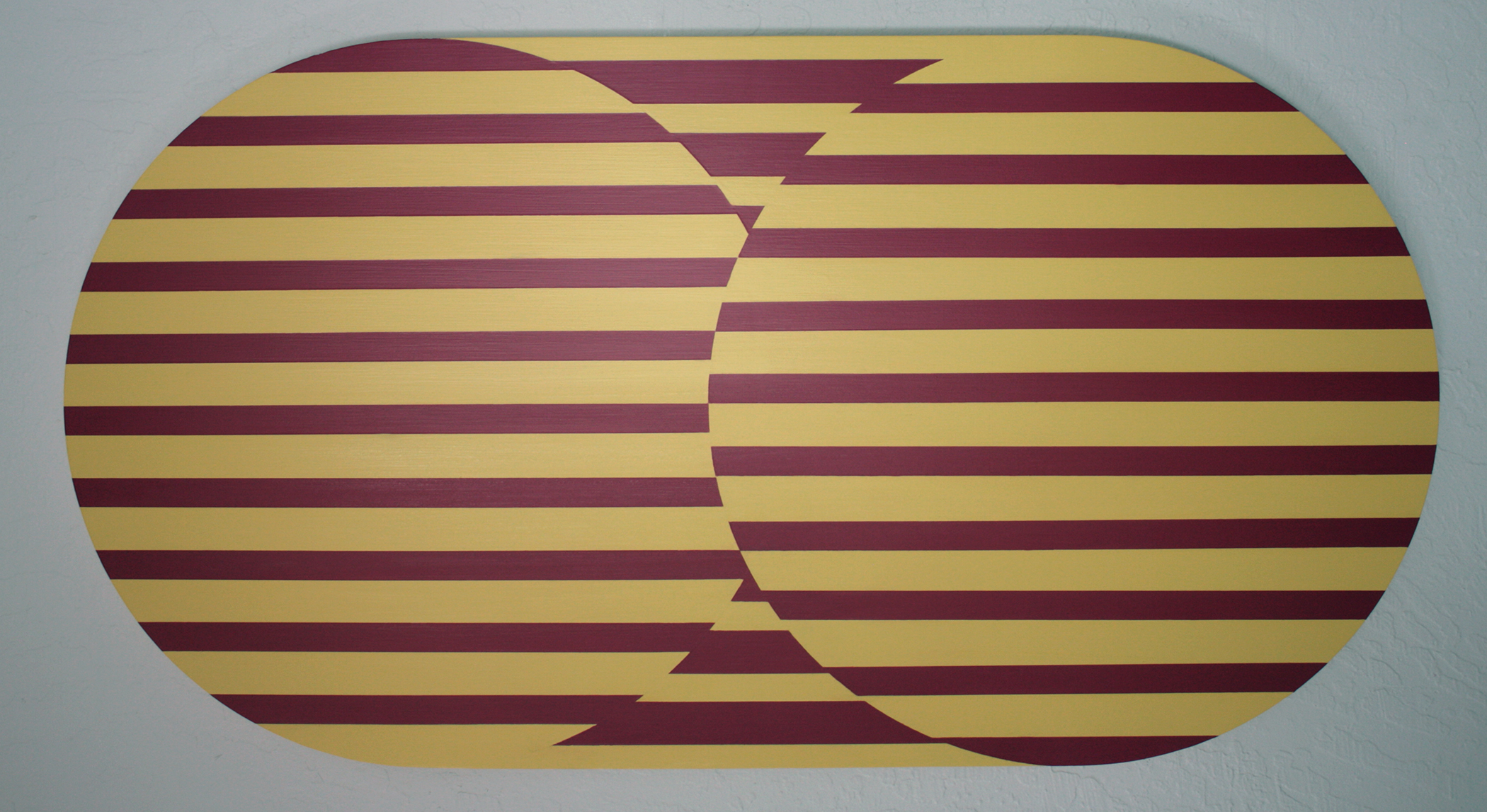 Brian Caraway, "Space Station," 2017, acrylic on panel, 24 x 45 inches, image courtesy of the artist and Chandra Cerrito Contemporary
Chandra Cerrito Contemporary is pleased to host an artist talk with Brian Caraway and Mitra Fabian led by Cathy Kimball, Executive Director of the San Jose Institute for Contemporary Art, on Saturday, July 15, at 2pm. Brian Caraway and Mitra Fabian have two concurrent solo exhibitions on display at Chandra Cerrito Contemporary from June 2-July 27, 2017. In Caraway’s Divine Madness and Fabian’s Natural Conduct, paintings and sculptural works explore the richness of repetition. Brian Caraway’s acrylic paintings are inspired by skateboarding culture, mathematical patterns, and the polyrhythms of modern music. Caraway uses a clean, controlled visual language that draws from 1960’s California hard-edge painting, color-field painters like Barnett Newman, and op-artists like Bridget Riley. Bands of vivid color of varying widths are masked off to create clear demarcations. Their linear patterns are devised through systems related to both math and musical rhythms. In some works, gradually diminishing or expanding bands create illusions of warped space; in others, visual vibrations result from interference between adjacent colors. Recently, Caraway has employed early skills he learned from building skateboard ramps to construct wood panels that are sloped or curved, emphasizing their sculptural quality and adding another dimension to the flatness or illusory space of the painted surface. Mitra Fabian’s intricate sculptures incorporate found objects, like electrical resistors and capacitors, recovered from computer manufacturing refuse. Swarms of these circuit board elements are embedded in porcelain structures or fastened to paper, resulting in biomorphic shapes reminiscent of coral, sea urchins or lichen despite their high tech components. Like artists Tara Donovan and Gay Outlaw, Fabian re-presents accretions of manmade materials in unexpected and evocative ways. In Fabian’s case, remnants from technology consumption are transformed into hybrids of the machined and the organic. In this duality, nature seems to dominate by providing the overriding sculptural forms, perhaps suggesting a long-term view in which even the most advanced human innovations will be subsumed by the natural world.