
Event
Bernadette Jiyong Frank: Spaces in BetweenPost an Event »
Dolby Chadwick Gallery
June 5 - July 5, 2014Info
-
http://www.dolbychadwickgallery.com/
-
(415) 956-3560
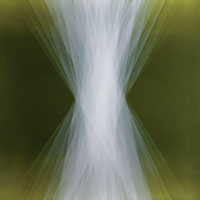
The lyrical geometry undergirding Bernadette Jiyong Frank’s paintings is a means for expressing the Japanese concept of ma, or the space between objects and events that is both empty and yet full of meaning. Ma maintains a constant presence throughout Japanese culture; it can be found, for example, in the meaningful pause at the bottom of a bow or the resonant silences between musical notes. Frank, who is of Korean decent but grew up in Japan, uses the intervals, spaces, and voids of geometric bodies to locate visual representations of ma. The geometric compositions are, in turn, informed by nature and light. As Frank explains:
“Mathematics is all around us. Nature reveals its beauty through geometry. You see it in the veins of leaves, in the way trees grow, in the patterns on the backs of insects and animals, and in the shape of the landscape. I am also attuned to light in nature. I observe how it shifts throughout the day and how it changes the color of the environment, or how it refracts and casts shadows that seem to dance against a wall. Personally, as an artist, it’s impossible for me to ignore these things.”
Numerous overlapping planes of varying tonal values cover Frank’s perfectly square compositions. Each new rectilinear plane is turned slightly askew to allow patterns and forms to emerge, giving the impression of, among other phenomena, light’s refractivity. Within this interplay of two- and three-dimensional space, math, measuring, and precision are prioritized, as is a concern for proportion. The works featuring corporal-like forms in The Spaces in Between series, for example, can be viewed as a modern-day interpretation of Leonardo Da Vinci’s Vitruvian Man.
But for Frank, mathematics and geometry are not ends-in-themselves but rather conduits for something deeper. Like Agnes Martin’s grid paintings and Naum Gabo’s kinetic sculptures, Frank’s paintings encourage us to transcend the visual limitations of everyday reality to commune with the rich, empyreal contours of our worlds and ourselves. Her heavy use of ponderous, Rothkoesque colors, such as midnight blue, deep purple, and dark grey, further facilitate this inward turn. These colors in conjunction with the scale of her panels also help recreate the solitary and disorienting experience of diving deep into a body of water, a situation Frank repeatedly put herself in while on a year-long sailing trip through the South Pacific during her late twenties.
During this adventure, Frank explains how she became acutely aware of the passage of time, or lack thereof: “the underwater experience [gives] me the sensation of floating in timeless space where the interconnection of self to the world was lost.” And because life on the boat was so simple, minutes felt like hours. This formative experience with time is directly recalled in Frank’s painting process. After applying white gesso to the panel, the artist spends the next several days laying down five to ten layers of acrylic paints. Once she achieves the right depth and tonality, she then moves on to oil paints. Due to the medium’s drying time, Frank is only able to paint one layer a day: “It can be painful and painstaking. But I learn to deal with this pain in a meditative way. I enjoy the process of going slow but digging deeper and deeper and adding another layer.”
Frank’s current works largely adhere to three different visual motifs, each of which captures the vitality of ma in a unique way. In half of The Spaces in Between works, an hourglass shape rendered through compact, fan-like layering emits a central, explosive energy. In the second half of this series, energy is more diffuse as billowing, veil-like patterns encourage the viewer to weave in and out of space. Finally, in the Void/Emergence paintings, the planes form a kaleidoscopic opening that allows an invisible force to burst through and into the viewer’s consciousness.