
Event
Christopher Reiger / Nomadic Nature In SituPost an Event »
senseofplace LAB
December 8 - December 8, 2013Info
1546 Pershing Dr. #C San Francisco, CA 94129 Google Map »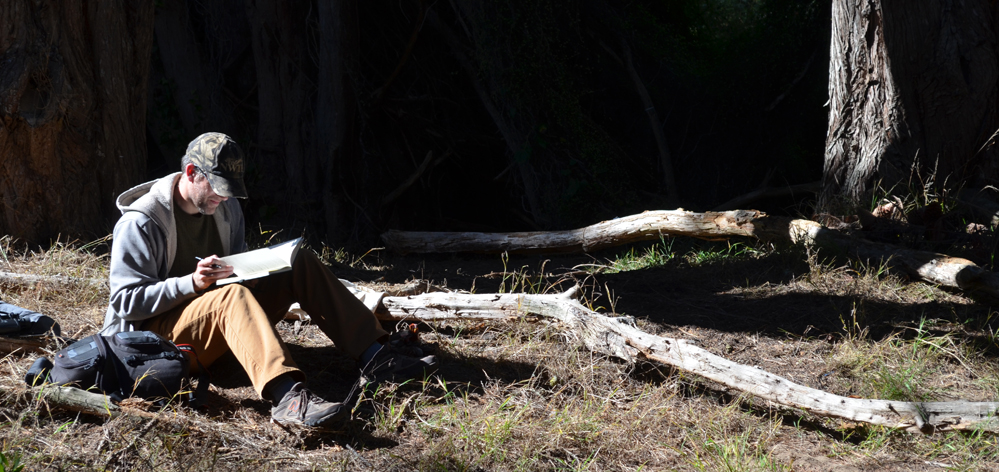
Compared to other societies, Americans are a peripatetic people. Too often, this relative restlessness diminishes our sense of place. Writer and artist Christopher Reiger is using his participation in Nomadic Nature in Situ to cultivate a deeper understanding of the ecology, history, and culture of the Bay Area, his home for the past three-and-a-half years. He writes,
"This place that I call home today is very unlike the place where I was raised, but it invites me to become better acquainted with it. I yearn to know the Bay Area more intimately, to come to know its contours, its rhythms, its aromas, but also to understand its political history, the origin of its street names, and the ecological changes it’s undergone.
To locate myself in a place, whether a particular site or a general region, I need to observe and understand the landscape, flora, and fauna; natural history is my principle 'way in.' Ecologists conduct traditional quadrat studies to obtain data on the plants, animals, soil, light, and weather of a specific area. To do so, they map out a square of set size -- typically ranging in size from 1x1’ or 10x10’ -- then identify and catalog all of the organisms they find in this plot. The researchers often extrapolate their quadrat findings to better understand the biodiversity of the surrounding habitat.
For “Presidio Sites," my Nomadic Nature in Situ project, I’m conducting an ongoing, nontraditional quadrat study. Each of my plots is 15x15’ or 20x20’ (significantly larger than a research quadrat), and I casually “sample” (via written descriptions, sketches, and photographs) organisms found in my four sites. I also catalog the trash I find, the sounds I hear, and the smells I experience, along with observations made from (not just within) the quadrat plots. I’m less interested in creating an objective report of the site ecologies than I am in the intangible, abstract, and subjective aspects of each site. Although I create detailed maps, prioritize biological specificity, and cross-reference my research, I also meditate on the mingling of my personal narratives and stories with the history and ecology of the Presidio sites."
On Sunday, December 8th at 2pm, Christopher will lead a walking tour to three of the four sites. At each stop, he will read a short reflection on some aspect of the site. The walking tour will conclude at 3:30, where an informal reception will take place. A number of Christopher’s photographs will be on view during this reception, and he will answer any questions attendees might have.