
Event
Teresa Baker and Jenny MonickPost an Event »
Read Our Review »Kiria Koula
March 15 - April 25, 2015Info
- http://www.kiriakoula.com/info.html
- (415) 848–2489
San Francisco, CA 94110 Google Map »
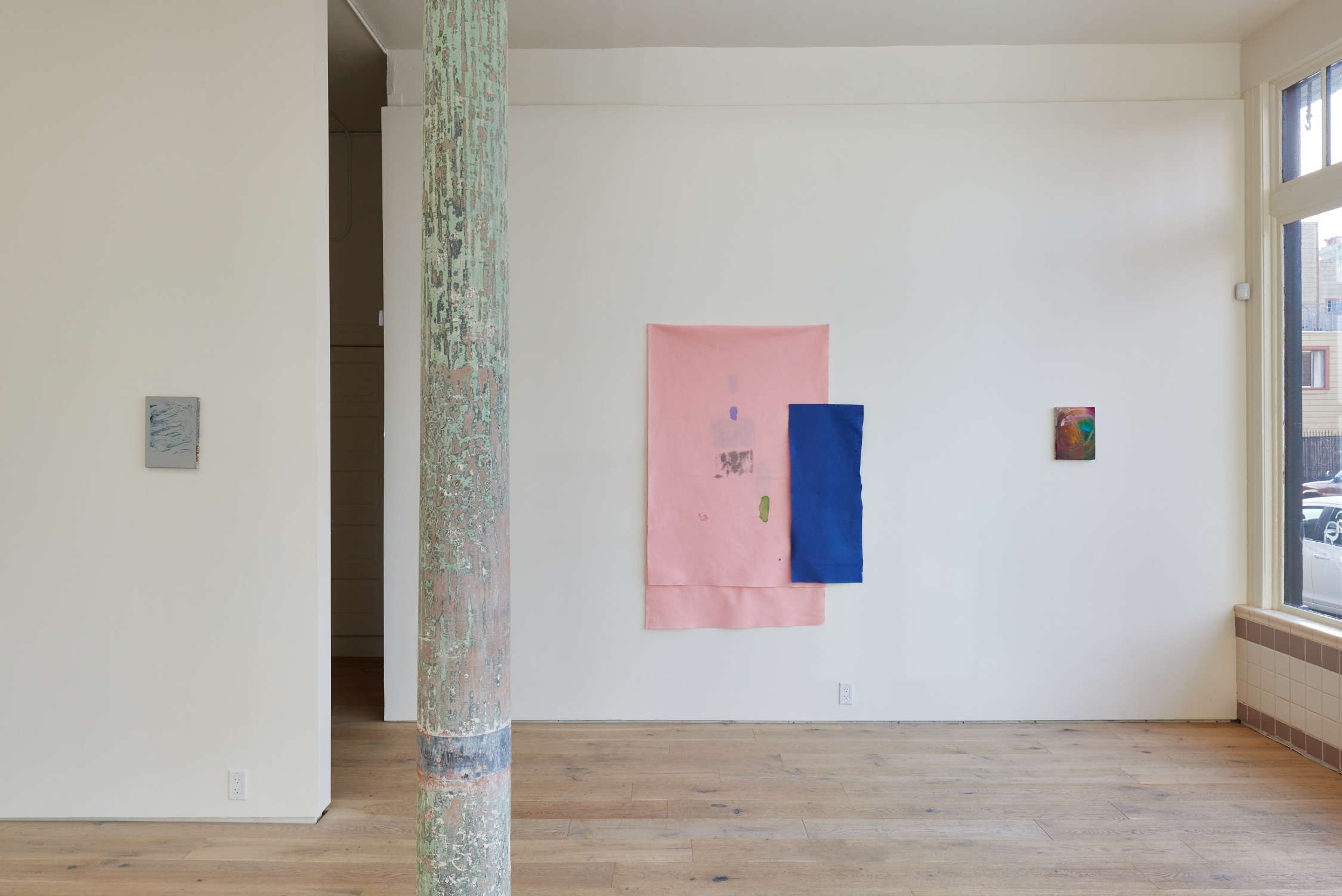
Jenny Monick practices painting with an idiosyncratic set of instructions, or a series of limitations she gives to herself. In a general sense, her work wonders what the frame of a painting can contain, and how it can be left open and undetermined. She creates porous boundaries where what is inside the frame of painting is never entirely cut off from what is removed. For this, Monick explores the notion of the grid and looks to act on it, to insert flaws into it, or, in her words, to use “wrong math” to invent her own alignments. By combining the essential elements of painting—stretchers, canvas, paint, color, brushstroke—the artist looks for informative accidents that occur along the way.
While studying anthropology as an undergraduate, Monick learned to observeand be sensitive to other people, objects, and the world around us. Recognizing her role as observer made her part of who and what she observed. Her fieldwork in Asia led to an interest in Taoism, a spiritual tradition anchored by the paradox of Wu wei, or action without action. As an artist, she carries this belief in essential simplicity and effortlessness and allows her organic and spontaneous experience with making work to be guided by a natural flow. Her project is to contain that sense ofemptiness and have a painting's inside frame its own outside.
For Kiria Koula, Monick presents a series of existing small-scale oil paintings rarely shown before, alongside a body of new works using enamel on raw linen and on canvas covered by numerous layers of previously “failed” paintings.
________
Teresa Baker is interested in objects that move slowly and that give the impression of change and growth as you spend time with them. To her, a work is finished once she is not longer able to identify it. She gives shape to things she cannot place and challenges the human instinct to categorize our relationship to form, material, and color.
Baker is particularly drawn to the potential of objects having a “life” and a “presence.” Having been raised Catholic and as a member of the Mandan-Hidatsa Native American tribe, she was exposed to objects that were considered “Sacred” and experienced the particular way people behaved in their presence. However, her works are not concerned with the symbolism of objects, and they don’t try to symbolize anything. Instead, she is interested in the material presence of objects as such and in their evolving relationship with the viewer.
For Kiria Koula, Baker presents a series of wall-mounted sculptural paintings composed of four main materials: felt, canvas, vinyl, and paint. Choosing these materials based on their color, texture, and sturdiness, she slightly alters the materials by folding them, cutting them, or making moderate paint marks on them, allowing herself (and other viewers) to look at and relate to the materials as they are.
“I don‘t work in a linear manner. Instead, I work by seeing connections between materials and responding to what each individual piece needs so that it can get to the point of non-identity. There is something in the process of unknowing that is of interest, and I believe helps to bring life to the painting. If I sketched it out and executed the plan, it would feel dry, a de-void of energy and life.”