
Event
Two GeologiesPost an Event »
Dolby Chadwick Gallery
February 6 - March 1, 2014Info
-
http://www.dolbychadwickgallery.com/
-
(415) 956-3560
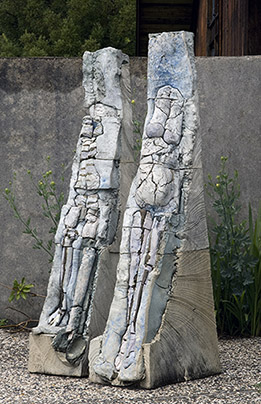
A two-person exhibition featuring the art of Danae Mattes (b. 1958) and Stephen De Staebler (1933-2011). As evidenced by their shared use of geologic motifs and emphasis on the organic properties of their materials—in this case, clay—both Mattes and De Staebler are deeply inspired by nature and the landscape. Engaging elements of landscape also allows both to ask questions about the human experience and to reflect on the human condition more broadly: how did we get here? Where do we go? As organic matter ourselves, what is our relationship to the rich, elemental body known as Earth? Two Geologies brings Mattes and De Staebler’s art into conversation in order to tease out these questions. While the selected works’ motivating concerns often run parallel to each other—threads that existed even prior to the artists’ marriage—they also occasionally diverge in vi sceral albeit complementary ways. This selected collection of art by Mattes and De Staebler offers powerful, open-ended explorations of the body’s connection to the earth and the earth’s connection to the body. Within the discourse generated between the works, questions of materiality prompt existential concerns, while the cultural imperatives of art ask us to consider processes of aesthetic creation.
For Mattes, the self in relationship to the environment has always served as a central fulcrum for her work. She maintains that the body, especially its vast network of circulatory channels and respiratory functions, mirrors the earth’s geologic and ecologic processes on a smaller scale. As such, the act of experiencing and discovering a particular landscape engages an act of self-discovery: as the landscape reveals itself, so too does the self. Mattes’s abstract, mixed-media wall objects are created using clay, paper, and pigment on canvas. Through years of experimentation, Mattes has developed a working process that enables her to deftly capture alluvial action, erosion, evaporation, and reformation. The viewer immediately notices how her surfaces evoke dry, cracked riverbeds: a pocket of deep cleavages, such as the one in Estuary III (2013), dramatically erupts near the center of the composition, as if a hot sun desiccated the clay at a breakneck pace. And yet, water is still evident. Imprints of dried, pigment-rich rivulets run down the face of the canvas, providing directional contrast (the fractal cracks were born horizontally, the drips, vertically) while adding a layer of geologic complexity. Finally, the hint of a horizon line automatically creates a space for the viewer to either directly or indirectly infer a human presence. By placing the self in the context of the work, Mattes hopes viewers develop unique, personal relationships to what they see—relationships that are their own despite having been prompted by her universalizing aesthetic.
Whereas Mattes’s work emphasizes the figurative relationships between the earth and the body, in many of De Staebler’s clay sculptures, the body and the earth literally become one. In Standing Man with Brown Knee (1975) a man’s body—including a discernable sternum, belly, legs, and feet—emerges out of what appears to be a cross-section of a mountain or hill. His embeddedness within the heavily striated rock underscores not just our earthly boundedness, but also our material essence: we are of the earth and we will one day return to the earth. These works complete a cycle that began with a series of landscape reliefs from the 1960s. Reminiscent of contemporary Land Art from the era, these heavy, low, horizontal sculptures evoke geologic formations and introduce latent biomorphic forms that would flourish in his later work.