
Event
William T. Wiley: & So… May Cuss Grate Again?Post an Event »
Hosfelt Gallery
December 11 - January 30, 2016Info
-
http://www.hosfeltgallery.com/
-
(415) 495-5454
Reception
December 10, 2015 6:00 pm to 8:00 pm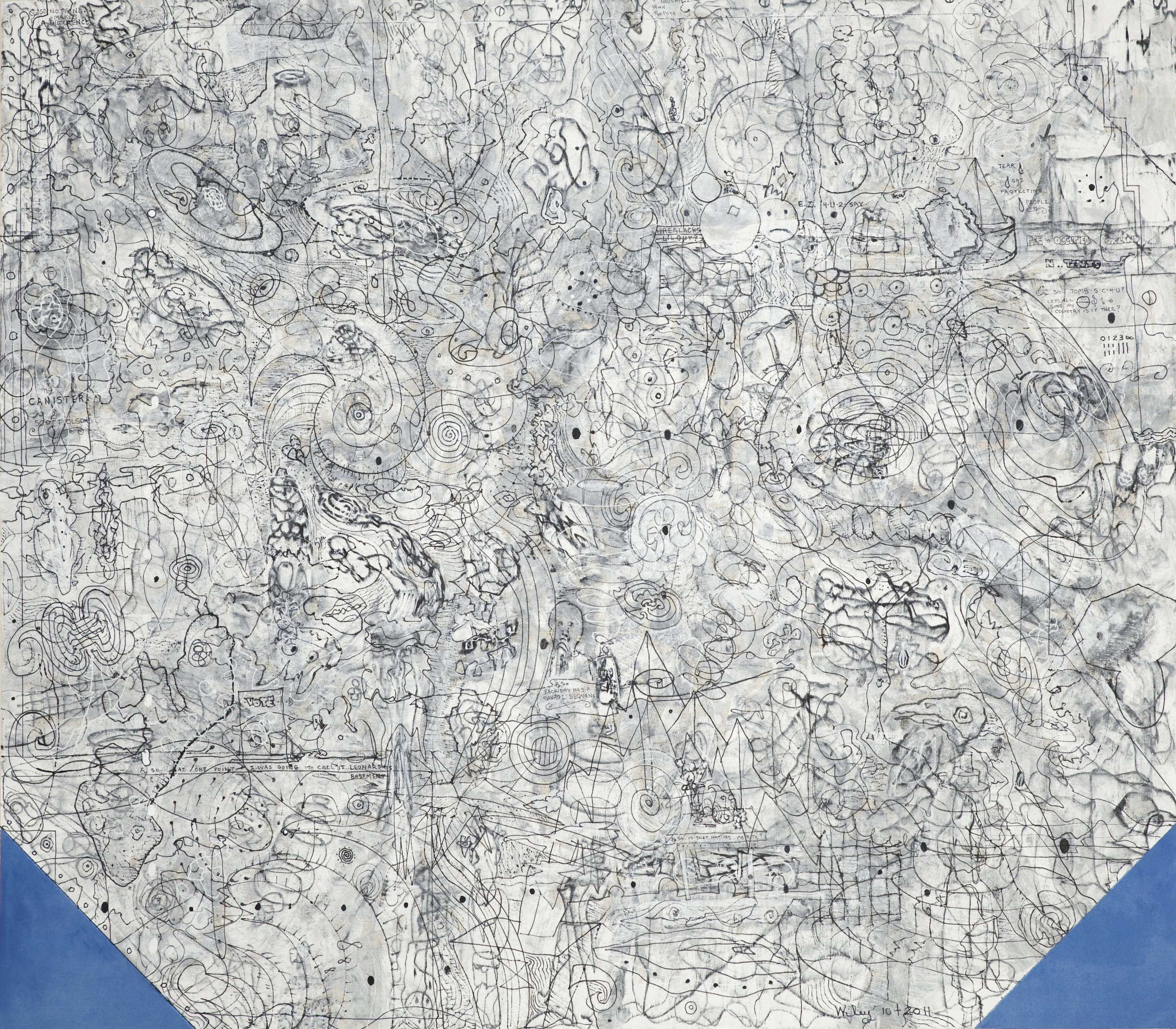 Unobjective Abstraction in Leonardo’s Basement with Blue Corners, 2011, acrylic on canvas, 62 x 70 inches [detail]
William T. Wiley’s second solo exhibition at Hosfelt Gallery sheds light on two important and under-examined aspects of Wiley’s oeuvre—his use of black and white and his interest in abstraction. In this show, eight large-scale paintings made from 2010 to 2015 are paired with a selection of watercolors to reveal references as diverse as the I Ching, contemporary social and political issues, and the history of abstract painting, all expressed using Wiley’s irreverent personal iconography.
Known for his use of bright colors, representational imagery and outbursts of quirky text, Wiley has also developed abstract black and white motifs since the 1960s. Striped sticks, representing the range poles used by surveyors, as well as scale markers on a map, are pervasive in Wiley’s work and function not only in the narrative of various works, but as a device to divide and direct attention within a composition. The black and white checkerboard calls attention to the picture plane—giving the eye a rest in an otherwise complex composition—or denotes an object of symbolic significance. But it also alludes to the chess game adored by one of Wiley’s primary influences, Marcel Duchamp.
Several of these new paintings are formally related to the hexagrams of the I Ching, the ancient Chinese divination text that had a notable impact on 1960s counterculture. Wiley was drawn to its symbology and the element of chance involved in the divination process. Its hexagrams are essentially black parallel lines which, on a page, read as black and white stripes.
The gestural turbulence of other paintings in this exhibition recall Wiley’s roots in Abstract Expressionism, with nods to Jackson Pollock and Franz Kline, as well as to Robert Ryman’s white and Ad Reinhardt’s black abstractions. While there are representational elements in these works—with sprinkles of text and color thrown in for good measure—the overwhelming effect is a sense of language deconstructed, magnified, and rendered indecipherable. There is an undeniable allusion to the chaos, incomprehensibility and absurdity of the current political climate, exemplified by the political campaign of Donald Trump and his slogan “Make America Great Again”—of which this exhibition’s title is a parody.
The watercolors in this show reveal the array of black and white motifs that have appeared regularly in Wiley’s work. Notably, his series of chalkboard slates, ongoing since 1974, depict musings and doodles in white chalk on a blackboard, often with dialogue between two characters—a (black) Raven and (white) Goat. These characters also appear in several of the recent black and white paintings, obscured in the swirls of paint or conversing in one of the corners, frequently standing in as Wiley’s inner art critics to question the relevance of abstraction in the 21st Century and the purpose of art in general.