
Kalavinka Dress (cont)
March 11, 2010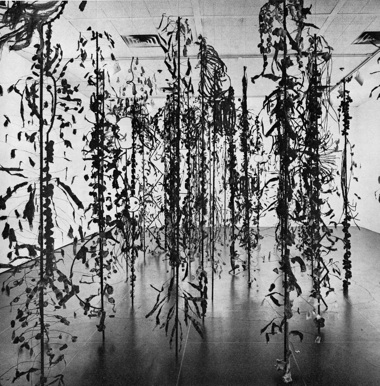
Besides the Kalavinka endeavors, I had other work happening. I was already a mother. I’d been writing fiction for years. And during the first year I lived in Toronto, I’d become captivated by sound poetry, after seeing footage at the Royal Ontario College of Art of an electrifying group of poets called the Four Horsemen of the Apocalypse. Their syncopated stutterings, wails, intonations and bleeps captivated me, and I couldn’t wait to try out the effect with my three young children. They rose to the challenge with boundless inventiveness and uninhibited joy. In a favorite exercise of what we called noise poetry, I’d play a tape of birds from the nearby zoo, riffing from a few peeps into a glorious mind-ripping chorus, while we jumped round the room jamming to their song. On occasion I also played our tapes back to birds. Soon, friends and relatives became part of the noise poetry, and we used words or phrases, growling and squeaking passages from Shakespeare, ancient chant or poetry. Improvisation was key. In a brief interview segment for Canadian radio, I was asked why we did it. I talked a little about free expressiveness and release of energy. The interviewer noted that I’d lived in at least seven cities and several countries. She seemed baffled by my need for these things, in contrast to steadier experience. She asked, “Do you think noise poetry may be a substitute for the rootedness that people have, when they live in a single place?”
Home is a highly personal ideal. The Sami have a word for “the home that lives in the heart.” Art happens under arduous conditions and in safe havens; it can come with fierce inward struggle or even seem to strike by itself; however the artist and the piece dialogue, invention triumphs. Art writing the way I learned it is different. Writing like a Kalavinka has let me feel blameless and safe in the act of witnessing beauty, intensity and the healing possibility of images forged in certain kinds of quests. Care for the earth figured in those quests. There was mutual belief that this art, this writing about it, had lifegiving value . . . that we could be players in an enduring circle.
Around thirty years later, after the turn of this century, I thought of how lovely it had been to hold those assumptions. Living in the Southwest, Washington, DC and San Francisco, I had long practiced willingly – needfully – the strenuous solid job and the arduous challenge of fiction. I remembered how hopeful and centered it once felt to be invited to use words, intimately exploring art. What about inviting myself? Maybe I could bring back some Kalavinka spirit, if only to see how it worked now, and whether it led me to art writing or something else. I felt hungry for that kind of unfolding.
I invented a dress about this, the Kalavinka Dress. It took time to collect three materials, in order to make it turquoise blue with shiny green lining and tomato red trim. I had Sami men’s dress in mind while I sewed. The dress shaped up somewhat like a straight-wide-sleeved costume of a Siberian shamaness I’d seen in artscanada long ago. Around the base of each sleeve there’s a soft, large band of the red trim, and a big band of it frames the circular neck, extending down the front to make a road for buttons. The wooden, lightly carved Chinese buttons are dark red, and ropelike loops to secure the opening extend from squares of white ivory. These have a configuration that reminds me of Viking design. All over the bright red, I embroidered with metallic silver thread. Many of the marks I made that way resembled some from deerskin
clothes, which I’d seen in an old book on Siberian tribes. I felt comforted by these shapes and I let them wander. It took me through an entire winter; evenings, I often sat with my daughter Karina, who had learned a neighborhood tradition of paño arte/handkerchief art, embroidering roses and borders in the Latino style of drawings and tattoos of our part of the San Francisco Mission. This shared plying of needles and color, and the different images we interpreted, invested my Kalavinka dress with quiet happiness.
The way I wear this Kalavinka dress is alone in my room, invoking images and writing about art. (One of the few times I’ve worn it publicly, I needed to buy groceries and decided not to change my clothes. Later, a neighbor girl reported to my daughter, “I saw your mom going to the store in her nightie!”)
At the same time that Kalavinka Dress is a state of mind, it’s a stance. It doesn’t require or forbid financial compensation for work, but it provides its own reward. It’s about the pursuit of a connection. When my friend Barbara had a gallery showing of large paintings downtown, I went to her opening with a notebook I keep ready to whip out for observations. Moving round the exhibition and visiting each painting, I recorded impressions of what the images meant to do – the world of assumptions and intent these paintings seemed to live in. Later I typed this up, revised, and imported a few pictures. I brought my piece to the gallery owners and asked if they might have a use for it. Their publicist sent it with a mailing to local reporters, and he kindly suggested I work with his advertising agency. It was tempting, but I knew that constant deadlines and covering art openings on demand wouldn’t lead to my right direction. If nourishment and healing aren’t part of the undertaking, Kalavinka Dress won’t work – it could go up in flames and burn away.
So many years had passed since I wrote for artscanada that I didn’t know what had happened to the publication or to Anne. One day, looking for her name on the internet, I came up with an entry connected to Meridian Gallery in San Francisco. It seemed unlikely we’d live in the same city, but I called anyway. The words on the other end: “She’s at lunch. Oh yes, I was just looking at an old issue of artscanada. Call back in half an hour.” After our beautiful reconnection – Anne had actually been living in the Bay Area longer than I had, after artscanada came to an end – she told me of a Tim Whiten exhibition in planning. Would I like to write about his work again? Of course I would. He now lived between Toronto and Brazil; soon we collaborated by phone, as he educated me on backstories of sculpture and drawings. When I asked about the symbolism of one, he referred me to a Greek myth I didn’t know, asked me to find out through my own research, and seemed delighted when I discovered his path by wandering through my own dark. I learned about Whiten’s development as a conscious healer through the years; and he told me enough of his history as a son, and his life as an artist, to deepen my reflections on his new work. Parts of what I wrote found their place in the exhibition and on the gallery web site. I sat alone with one of Whiten’s glass skulls that deliver memories you’ve never had. I believed again in the blessings of Kalavinka Dress.
As I write this now, I’m far from any home I’ve known. My beautiful thirty-one-year-old daughter Cielo became critically ill and I flew to North Carolina. For the next month she struggled on assisted breathing. Finally came an eerie, exultant day when she could stand – and then, trailing machines and an oxygen canister, she insisted on walking the eight-hundred-foot loop around Intensive Care. All the plastic is finally taken out of her throat. Her doctor says she’ll recover. How to hold fast in such danger? She does. This kind of road is long; she’s taken her stand.
To take a stance can mean so much. I’m remembering what I take on, when I put on Kalavinka Dress. Recollecting tries to collect again. To gather. Not long after Cecilio and I were with Sarain he traveled to Mexico, where he’d longed, he said, to learn about ancient native people. He’s reported to have drowned there. Sarain told us he was born in Italy to an Italian mother and a Shoshone father he never met, a serviceman stationed there – that he’d run away to America as a young boy. Biographies say he was born on a Shoshone reserve, but I understood him to have found the self we knew through Shoshone people later. I wonder whether Sarain continued on in Mexico, reinventing himself. When he gave us the sounds of children singing to bring the sun, he cautioned me not to listen often. I’m careful to save it for rare moments. Now, thousands of miles from the recording, I hear those voices in dawn mist wheeling in my mind. The children’s open-throated chanting brings my tears. It invokes inexplicable things. And how we’re children before them.
Image: Nancy Graves. Variability and Repitition of Variable Forms, 1971; steel, latex, gauze, marble dust, acrylic, and wax. Courtesy of Anne Brodzky. Photo: Eberhard Otto.