
Shotgun Review
A Tree for Roxy Paine
February 27, 2012In April 2011, the Nelson-Atkins Museum of Art installed Ferment, the twenty-fifth iteration of Roxy Paineʼs steely Dendroid franchise, on the south lawn of the museum. It arrived with great fanfare, of course, with speeches and panels and ribbons and bows. It was hailed in the press as a new icon on the cityʼs cultural horizon. Films of the installation were posted on the web. Social networks were employed.
The museum’s newly-appointed director, Julian Zugazagoitia, declared: “This tree will bear fruit for future generations of artists.” Jan Schall, Curator of Modern and Contemporary Art, proclaimed: “Ferment will be the reigning monarch on that hillside.”
The carefully staged unveiling of Ferment came off without a hitch, and the public has since embraced the piece accordingly. Its theatricality is undeniable, and its implications are comfortably vague—yet it almost suggests that dystopia might not be such a bad place after all.
Apart from the general public, however, and contrary to Zugazagoitiaʼs bubbling Edenic optimism, many artists in Kansas City cast wary eyes on this Dendroid. Its arrival seems more akin to the opening of a new Bass Pro Shop, or an IKEA, than an art event. Its benefits are remote, its dialogue rehearsed, its beauty wholly subsidized—a hollow meme of contemporaneity.
But there is hope.
Shortly after the dedication of Ferment, another tree appeared on the museum lawn, just south and east of the Dendroid: a tidy sapling, Acer saccharum, otherwise known as a sugar maple. This particular tree does not belong to the museum.
A Tree for Roxy Paine was planted in the middle of the night by the Minister of Information, a local artist who resides in the margins of the art scene. As of this writing, nearly a year later, the museum is still unaware of its presence.
The Ministerʼs tree is not a critique. Quite the contrary; its effect is to make Ferment soboliferous, as if the sculpture has
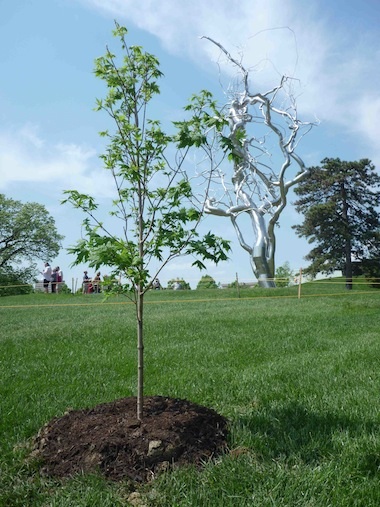
The Minister of Information. A Tree For Roxy Paine, May 2011; digital photo. Courtesy Warrior Ant Press.
underground stems that form new plants nearby. It presides as a subliminal volunteer, ennobling a piteous monarch that would otherwise stand lifeless and alone upon the hill. It is a gesture that indemnifies both Paine and the museum against the childish notion that the world should behave any differently here than it does anywhere else.
Sooner or later, the museum will recognize the Ministerʼs tree as an unwelcome visitor, and it will be removed. It must be done. In the meantime, A Tree For Roxy Paine is well worth a visit. It reminds us that beneath the rigid canopy of an inevitable market there exists another world, teeming with life.
A Tree for Roxy Paine is currently on view on the grounds of the Nelson-Atkins Museum of Art, in Kansas City, MO.
A. Bitterman is an artist and writer in Kansas City where he lives with his cruel, rancorous wife, Mrs. Bitterman, and their five despicable children. Since his last good night's sleep in 1998, he has spent the better part of 12 years trying to use the word "soboliferous" in a sentence.