Shotgun Review
In Case You Missed It: Seduction: Japan’s Floating World
May 10, 2015The exhibition Seduction: Japan's Floating World at the Asian Art Museum transports visitors to the provocative entertainment districts of modern-day Tokyo. “Floating world,” or ukiyo, describes the carefree, pleasure-seeking lifestyle represented in the exhibition’s sixty works of art from Japan’s Edo Period (1615–1868).
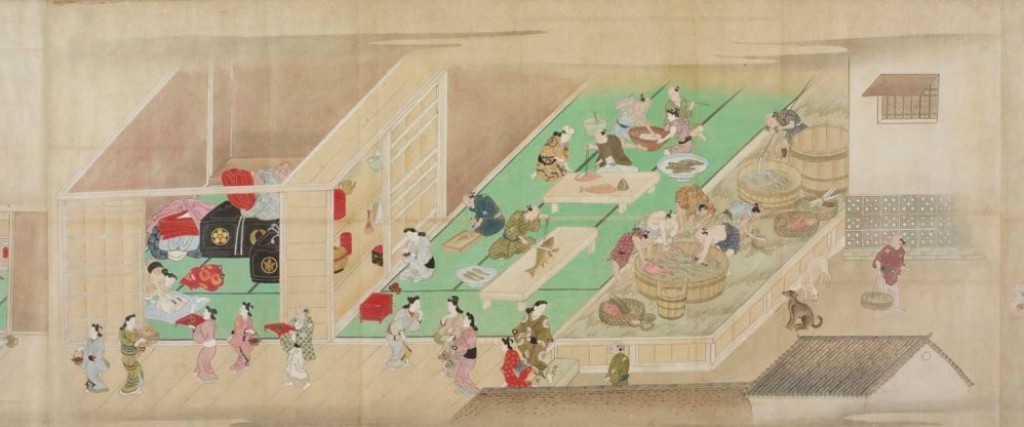
In an astounding fifty-eight-foot scroll, A Visit to the Yoshiwara (c. 1680s) by Hishikawa Moronobu, the district’s sprawling sex trade is depicted and viewers are presented with an omniscient point of view. Samurais, who were not permitted to enter, are shown here with the hilts of their swords jutting out from under their robes, humorously exposing their disguises. Behind the latticed walls, prostitutes can be seen providing their services, while high-ranking courtesans wearing pastel-colored garments stroll down the main avenues. In A Visit to the Yoshiwara, each character’s placid expression exemplifies the notion of ukiyo; it is absent of any sense of personal history or a general awareness of suffering. In this absence, the risk of romanticizing Edo’s history is introduced and becomes overwhelmingly problematic.
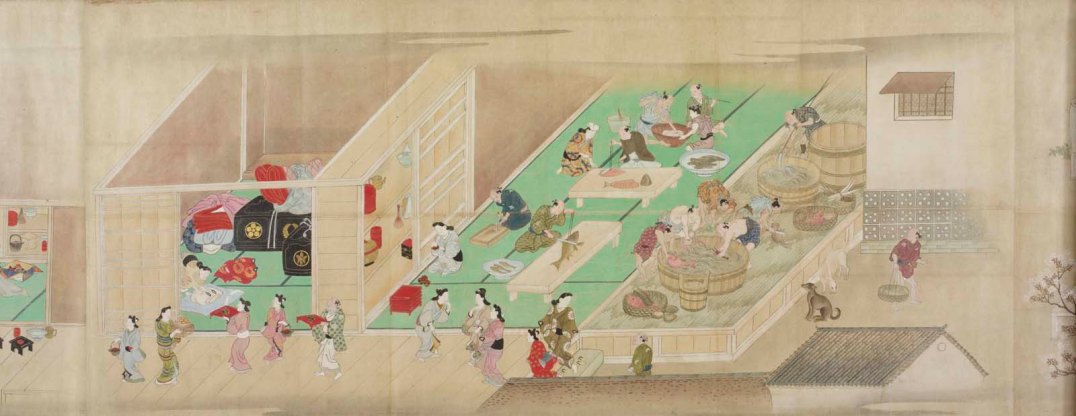 Hishikawa Moronobu. A Visit to the Yoshiwara, late 1680s (detail); hand scroll: ink, colors, and gold on paper. Courtesy of the John C. Weber Collection and the Asian Art Museum, San Francisco.
Hell Courtesan (c. 1850), an elaborate portrait of a 15th-century prostitute by Japanese grand master Utagawa Kuniyoshi, seeks to correct this misguided notion. The courtesan, who was said to have been guided to enlightenment by a Zen monk, gazes over her left shoulder at viewers. Her delicate chin is shyly hidden beneath the fabric of her cloak, which depicts a scene of eternal damnation, with fiery red clouds hovering over smiling bushy-faced demons. Though much remains unsaid, the tension between the courtesan and the seemingly real demons lends to a more dimensional representation of her plight.
The exhibition effectively communicates the notion of Edo’s ukiyo, but there's an inherent clash between the exhibition’s display and the history of the period. What cannot be fully discerned from the narratives presented in Yoshiwara and Hell Courtesan is the significant role that child prostitution played in Edo Japan’s history. This and other ugly realities remain untold from the exhibition’s larger narrative of seduction. When one arrives at this realization, the mockery of the demonic faces on the Hell Courtesan’s cloak become all the more palpable and the tenderness of her expression transfigures into something more tragic. A glance back to Japan’s era of seduction proves to be one clouded by a contemporary desire to float beyond certain realities.
_______
Jack Delacruz is a poet and fiction writer currently pursuing his MFA in Writing and working towards a career in teaching.
Seduction: Japan's Floating World was on view at the Asian Art Museum through May 10, 2015.